2026-08-25 22:12

速览
本文来自微信公众号: IPP评论 ,作者:徐伟钧
导语:随着AI图像生成、自动化视频制作和算法传播工具快速发展,在日本网络空间中,已出现利用生成式AI批量制作具有排外倾向、民族主义色彩甚至涉及历史认知争议的内容现象。据《朝日新闻》等日本媒体报道,CrowdWorks等众包平台曾出现招募制作“嫌中”类YouTube视频的项目,要求制作者利用AI完成图片生成、脚本撰写、旁白制作和视频剪辑,内容通常围绕“中国威胁”“日本优越性”以及对韩国负面叙事展开,并通过短视频平台进行传播。
在IPP副研究员徐伟钧看来,AI技术正在改变日本右翼言论以及历史修正主义内容的生产逻辑。过去,相关叙事主要依靠政治人物、右翼团体、出版机构和传统媒体传播,而生成式AI降低了内容生产门槛,使其能够以更低成本、更大规模和更具视觉冲击力的方式进入公众视野。尤其是在战争记忆越来越依赖影像资料和数字媒介的时代,AI生成内容可能进一步模糊事实与虚构之间的边界,并改变公众历史认知的形成方式。
文章原题为“Japan's right wing is turning AI into a new tool of historical revisionism”,于2026年8月22日发布于CGTN官网。
本文作者
徐伟钧博士
华南理工大学公共政策研究院(IPP)副研究员
近期,围绕“日本利用AI篡改侵华历史”的讨论引发关注。从目前能够核实的材料看,日本网络空间中确实出现了利用生成式人工智能批量制作反华、排外甚至历史修正主义内容的现象。同时,日本政府近年来也在持续强化围绕国家形象、历史认识和国际叙事的战略传播能力,并开始将AI纳入信息搜集、舆情分析和所谓“认知战”应对的官方体系。这两种趋势叠加所产生的潜在风险不容小觑。
人工智能正在明显改变日本右翼言论的生产方式与传播逻辑。日本《朝日新闻》披露,在CrowdWorks等众包平台上,曾经出现大量招募制作批评中国类视频的项目,要求制作者利用生成式AI完成图片、旁白、脚本和视频制作。[1]这类内容基于预先设定的政治和民族主义立场,再通过AI批量制造迎合受众情绪的虚构故事,本质上是工业化生产的意识形态产品。
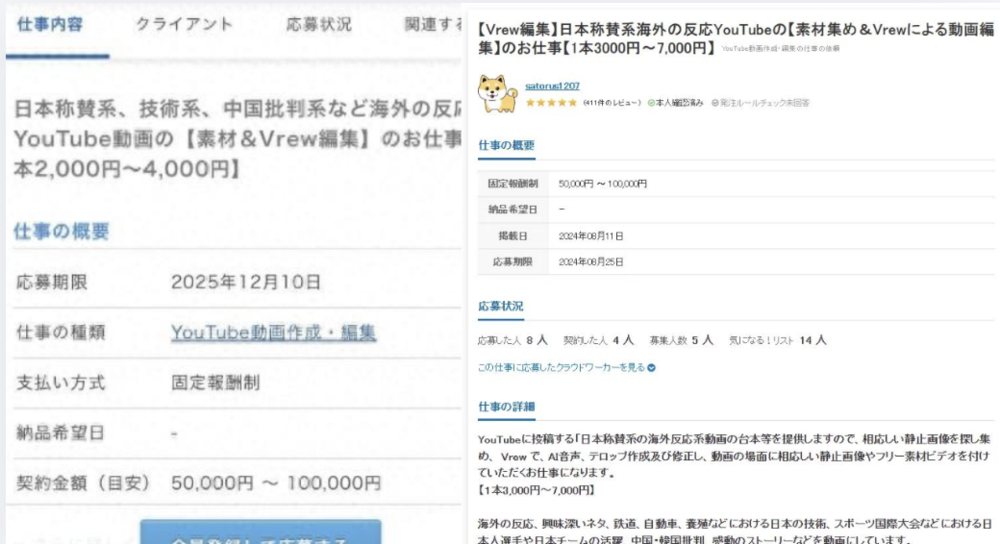
日本众包平台CrowdWorks曾出现招募制作“海外反应类”YouTube视频的任务,内容涉及“批评中韩”等主题,要求制作者完成素材收集和视频编辑。
过去,日本历史修正主义和排外主义内容的传播,主要依赖于右翼政治人物、团体、出版社以及少数具有明确政治倾向的媒体。尽管这类内容长期存在,但其生产成本相对较高,传播范围也受到一定限制。生成式AI打破了这些限制。现在,个体只需要输入简单提示词,就可以迅速生成大量图片、声音和视频,再通过YouTube、TikTok等平台传播。右翼内容由此实现了低成本、批量化甚至流水线式生产,其传播效率与覆盖范围大幅提升。
更值得警惕的是,这类内容的生产已经不再完全依赖传统右翼活动群体。部分参与者没有明确的政治立场,他们只是因为此类视频更容易获得点击率、更容易获得收益,便按照发包方要求进行制作。这意味着,日本右翼话语正在与平台经济形成一种新的结合。排外、仇外和历史修正主义的内容越具有情绪性和冲击力,就越容易获得流量。而AI又大幅降低了制作这些内容的成本,进一步刺激产能扩张。右翼意识形态、注意力经济与生成式AI正在形成相互强化的势头。
当这种模式延伸到历史问题领域,其危害会更加严重。南京大屠杀、慰安妇问题、日本殖民统治等历史议题,本来就长期遭到日本右翼势力的否认、淡化和歪曲解读。过去,历史修正主义更多通过文字论述、教科书修改或者政治人物言论来传播。AI则推动了这种修正主义叙事的全面视觉化。它可以制造看似真实的“历史照片”,生成不存在的“历史人物证言”,甚至通过虚构场景重新塑造公众对战争的记忆。对于缺乏专业历史训练的普通受众而言,这类视听内容往往比传统的文字材料更具欺骗性。
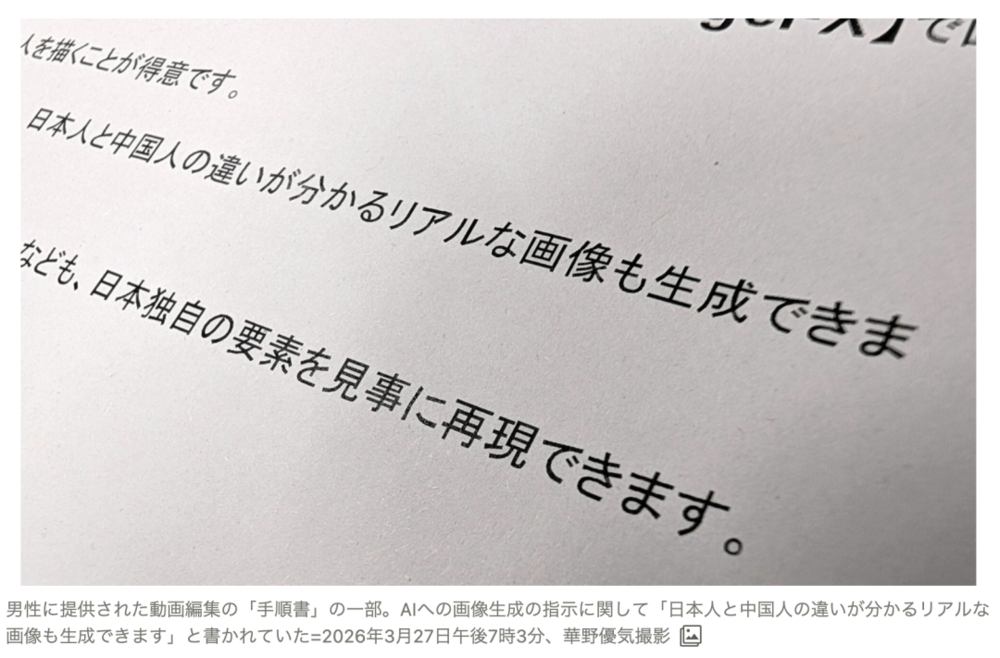
日媒报道的AI辅助视频制作指南截图。其中包含利用AI生成“日本人与中国人的差异”等图像的说明。图源:日本《朝日新闻》
随着战争亲历者逐渐减少,公众对历史的认知越来越依赖影像、纪录片和数字资料。如果大量由AI生成的内容混入更广泛的历史资料中,真假之间的界限将变得更加模糊。届时,历史修正主义带来的影响将不仅限于“重新解释历史”,还可能逐渐制造出一套具有视觉真实性的替代性历史记忆。
因此,日本右翼势力利用AI生产相关内容的行为,不能被简单视为少数网络账号的猎奇之举。这可能会从根本上改变历史修正主义未来的传播形态,从而造成严重后果。
近年来,日本政府已经明显强化对国际舆论、国家形象和历史认识问题的战略传播,并开始把信息空间视为国家安全竞争的重要组成部分。与此同时,AI正在被用于舆情监测、信息分析、虚假信息识别以及传播效果评估等环节。日本外务省2026年度预算文件已经明确提出应对“包括历史认识在内的叙事信息战”,要求加强信息搜集、分析和传播,并进一步利用包括AI在内的新兴技术。虽然目前还没有直接证据显示日本政府已经直接组织利用AI篡改侵华历史,但未来这些趋势可能发生制度化结合的风险不容忽视。
历史认识长期是日本政府对外传播中的重要议题。虽然日本政府的正式立场与极端右翼的历史否认论存在差别,但日本官方在南京大屠杀遇难人数、慰安妇问题以及殖民统治责任等问题上,长期坚持自身的片面解释,并不断强化向海外传播这些解释的力度。如果未来AI被用于受众画像、大规模内容生成和精准投放,日本政府便无需公开否认历史。通过选择性呈现史料、突出有利于日本的解释、淡化侵略责任,或者放大将历史问题描绘为本质上“存在争议”的叙事,日本政府就可能在国际舆论中产生比传统历史修正主义更加隐蔽的传播效果。
对此,中国需要保持高度警惕。有必要持续追踪日本政府的介入动向,密切关注日本战略传播预算的分配与使用情况,警惕历史认识被进一步纳入所谓认知战和信息战框架。还应重点监测AI是否从目前的信息分析工具逐渐扩展为大规模内容生成和精准传播工具。
参考资料:
[1]朝日新聞,“「嫌中」動画AIで量産の現場「軽い気持ちで」男性が語った後悔”,2026年4月9日,https://digital.asahi.com/articles/ASV433CJMV43UTIL02DM.html?iref=comtop_7_01。
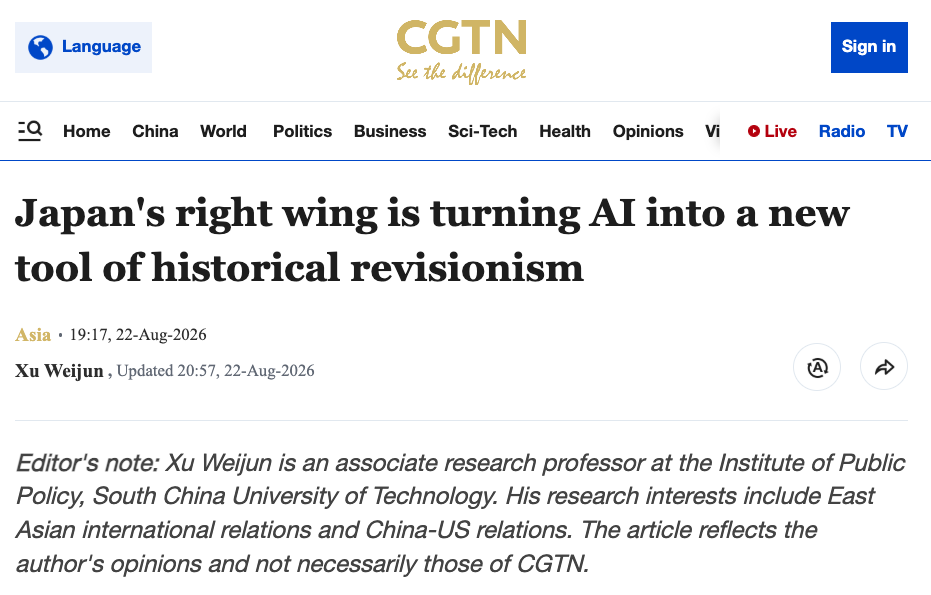
文章原题为“Japan's right wing is turning AI into a new tool of historical revisionism”,于2026年8月22日发布于CGTN官网。
徐伟钧
华南理工大学公共政策研究院副研究员
*以下为英文版,供读者对照参考。发表时内容有所删改。(上下滑动查看)。
Recently,discussions over“Japan is using AI to distort the history of its aggression against China”have attracted attention.Based on currently verifiable materials,there is indeed a phenomenon in the Japanese cyberspace where generative AI is being used to mass-produce anti-China,xenophobic and even historically revisionist contents.At the same time,the Japanese government has in recent years continued to strengthen its strategic communication capabilities concerning Japan’s national image,historical perception,and international narratives,while beginning to incorporate AI into official systems for information gathering,public opinion analysis,and responses to so-called“cognitive warfare.”The potential risks arising from the convergence of these two trends should not be underestimated.
AI is significantly altering both the production methods and dissemination logic of Japan’s right-wing discourse.Japan’s Asahi Shimbun has reported that crowdsourcing platforms such as CrowdWorks have hosted numerous projects recruiting creators to produce videos critical of China,with contractors instructed to use generative AI to create images,narration,scripts,and videos.Such contents are based on pre-determined political and nationalist stances,with AI then used to mass-produce fictional stories that cater to audience emotions.In essence,these are ideologically driven products generated through an industrialized production process.
In the past,the dissemination of historical revisionist and xenophobic contents in Japan relied primarily on right-wing politicians,groups,publishing houses,and a limited number of media outlets with clear political orientations.Although such forces have long existed,the cost of producing contents was relatively high and their reach remained constrained.Generative AI has broken through these barriers.Now,individuals need only enter simple prompts to rapidly generate large quantities of images,audio,and video,which can then be disseminated through platforms such as YouTube and TikTok.Right-wing contents can therefore be produced at low cost,in large volumes,and even through assembly-line processes,with a significant increase in both the efficiency and reach of dissemination
More alarmingly,the production of such contents no longer relies entirely on traditional right-wing activist groups.Some participants do not hold clearly political convictions.They simply produce such videos at the request of clients because the contents are more likely to attract clicks and generate revenue.This suggests that Japanese right-wing discourse is developing a new relationship with the platform economy.The more emotional and provocative xenophobic,anti-foreigner,and historically revisionist content becomes,the more likely it is to attract traffic.AI has sharply lowered the cost of producing such contents,further stimulating an expansion in production capacity.Right-wing ideology,the attention economy,and generative AI are thus becoming mutually reinforcing.
The risks become even greater when this model is extended to the realm of historical issues.Issues including the Nanjing Massacre,the“comfort women”issue,and Japan’s colonial rule have long been subject to denial,minimization,and distorted interpretations by the Japanese right-wing forces.In the past,historical revisionism was disseminated mainly through written arguments,textbook revisions,or statements by political figures.AI has facilitated the comprehensive visualization of revisionist narratives.It can produce seemingly authentic“historical photographs,”generate fictional“testimonies from historical figures,”and even reshape public memories of war through fictionalised scenes.For ordinary audiences without professional training in history,such audiovisual contents are often more deceptive than traditional written materials.
This danger is particularly serious as the number of those who witnessed the war continues to decline and public understanding of history becomes increasingly dependent on images,documentaries,and digital archives.If large number of AI-generated contents are mixed into the broader body of historical materials,the boundary between truth and fiction will become increasingly blurred.The impact of historical revisionism would then go beyond merely“reinterpreting history”and could gradually produce an alternative historical memory that possesses a misleading sense of visual authenticity.For this reason,the use of AI by Japan’s right-wing forces to produce such contents should not be dismissed as sensational behaviour by a handful of online accounts.It could fundamentally alter the future form of dissemination of historical revisionism,leading to serious consequences.
In recent years,the Japanese government has markedly strengthened its strategic communication concerning international public opinion,national image,and historical perception,while increasingly regarding the information space as an important component of national security competition.At the same time,AI is being applied to public opinion monitoring,information analysis,the identification of disinformation,and the assessment of communication effectiveness.The Japanese Ministry of Foreign Affairs’fiscal 2026 budget documents explicitly refer to responding to“narrative information warfare,including that concerning historical perception,”requiring the strengthening of information collection,analysis,and dissemination,as well as greater use of emerging technologies including AI.Although there is currently no direct evidence that the Japanese government has already directly organised the use of AI to distort the history of its aggression against China,the risk of a future institutionalised convergence between these trends cannot be overlooked.
Historical perception has long been an important issue in the Japanese government’s external communications.Although the Japanese government’s official position differs from the historical denialism of the far right,Japanese authorities have long maintained their own one-sided interpretations of issues including the death toll of the Nanjing Massacre,the“comfort women”issue,and responsibility for colonial rule,while continuously strengthening their efforts to disseminate these interpretations abroad.If AI is eventually used for audience profiling,large-scale content generation,and targeted dissemination,the Japanese government would not need to deny history openly.By selectively presenting historical materials,highlighting interpretations favourable to Japan,downplaying its responsibility for aggression,or amplifying narratives that portray historical issues as inherently“contested,”it could exert an influence on international public opinion that is more subtle and difficult to detect than traditional forms of historical revisionism.
In this regard,China must remain highly vigilant.It is necessary to continue monitoring potential Japanese government involvement,remain alert to the allocation and use of strategic communication budgets,be wary of historical perceptions being further incorporated into so-called“cognitive warfare”and“information warfare”frameworks.Particular attention should be paid to whether AI,currently used primarily as a tool for information analysis,gradually expands into large-scale content generation and targeted communication.
本内容来源于网络 原文链接,观点仅代表作者本人,不代表虎嗅立场。
如涉及版权问题请联系 hezuo@huxiu.com,我们将及时核实并处理。
如涉及版权问题请联系 hezuo@huxiu.com,我们将及时核实并处理。