

2014-07-10 13:10
扫码打开虎嗅APP


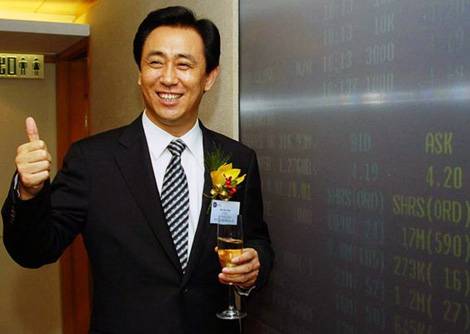
Mr. Hui Ka Yan (Xu Jiayin, 许家印) is the owner of Guangzhou Evergrande Soccer Club, the newly champion of Asian Champions League. According to Forbes, his net worth is $5.4 billion as of October 2013. He chairs Hong Kong-listed Evergrande Real Estate Group.
1. Mr. Hui Ka Yan’s (Xu Jiayin) father was a Chinese revolutionary veteran, who joined the Communist Party at the age of 16 and fought in the eight-year Anti-Japanese War as a cavalry company commander. As his mother died of sepsis when he was less than one year old, Hui had to live with his grandmother since then.
2. Hui has a sketch of his grandmother hung on the wall in his house. It was drawn by Hui when he was little. Having developed a keen interest in painting at an early age, Hui usually drew grids on a piece of white paper with a pencil before he started sketching. He was also fond of DIY projects and has made an electric torch with iron and electric wires.
3. Hui started his first business attempt upon graduation from high school by selling slaked lime collected from the village. But while going down a slope, he lost control of the cart and the lime ended up scattering all over the ground. It was in the year of 1974, which Hui Ka Yan still remembers clearly. When he was at university, Hui, together with some classmates, brought some apples to Wuhan for sale, which turned out to be a total failure as all the apples had rotted before they arrived there.
4. It was after his graduation from high school that Hui Ka Yan became determined to escape from the village. He had thought about becoming a tractor driver, for he believed that driving was a skill that could change his life. He even treated the head of the village and the party secretary to drinks, hoping to facilitate the process. Later on, when he was told that his neighbour’s uncle worked at the security bureau of the city of Zhoukou, he started writing to the uncle, requesting a job in the city. But nothing came out of it in the end. Hui has worked afterwards as security guard and night-soil collector.
5. In 1976, hearing the news of the restoration of the university entrance exams, Hui Ka Yan immediately applied for the test. Having failed in his first attempt, Hui spent five months preparing in the second year by sitting in high school classes. He even pulled some strings and got himself a flat near his high school. Eventually, ranking the third in the city of Zhoukou, Hui was successfully enrolled in the Wuhan Institute of Metallurgy (the present Wuhan University of Science and Technology). He received a Titoni watch from his father as a present.
6. At university, Hui’s duty as a “sanitation monitor” was to talk to his fellow students, assign and supervise group cleaning activities. “The job of a sanitation monitor is all about persuasion,” said Hui, “you have to go door to door to find people.” Hui spent two thirds of his time at university on student activities, which equipped him with excellent interpersonal skills.
7. Hui’s favourite night snack was the hot dry noodle, a popular dish in Wuhan. He said five out of his ten night snacks turned out to be the hot dry noodle, which only cost 0.1 yuan back then. As a university student, Hui received a monthly subsidy of 10 yuan.
8. Upon graduation, Hui Ka Yan was assigned a job at the Wuyang Steel Mill in Henan Province. Hui was very resentful about the appointment to the post in such a “tiny valley” as Wuyang, believing that his university education should bring him to big cities. However, He gradually came to familiarize himself with the skill of management. Two months into his work, Hui developed regulations such as “300 rules on production management” and “150 degree evaluation”, i.e., anyone who was found bending their body over 150 degrees and dozing off at work would be fined. With Hui’s stories spreading across the plant, colleagues began to praise his brilliant ideas and expertise in management.
9. Having saved 20,000 yuan after ten years at the steel mill, Hui Ka Yan envisaged a greater opportunity after Mr. Deng Xiaoping’s speech in southern China. In 1992, Hui came to Shenzhen and got a job as salesman, which has further expanded his horizon. Three years later, Hui’s boss wanted him to lead a team in Changchun, a city in northeast China. But after careful consideration, Hui suggested and convinced his boss into exploring the market in Guangzhou, the provincial capital. Arriving in Guangzhou, the aspiring sales supervisor registered a real estate company named Pengda, where he still worked as a team leader, for the same old boss.
10. Having worked for five years in Guangzhou, Hui Ka Yan grew tired of working for others, for he was still making 3000 yuan a month even he managed to win a contract with 200 million net profit. Believing that he deserved more than that, Hui founded Evergrande.
11. In 2008, the financial crisis hit Evergrande which then was planning to go public. It was a huge risk for Evergrande, for failures to become listed and obtain a bank loan were crucial for the cash-reliant real estate industry. Hui managed to find an overseas investor, which later opted out of the deal due to Evergrande’s enormous debt. In order to cash in quickly, Hui Ka Yan waged a price war. When Evergrande was at its worst, there was only two billion yuan on the books. As a result, he now has two basic requirements for Evergrande: cash balance should always be higher than 10 billion yuan; and 60% of annual target should be achieved by the first half of each year.