2014-11-07 11:05
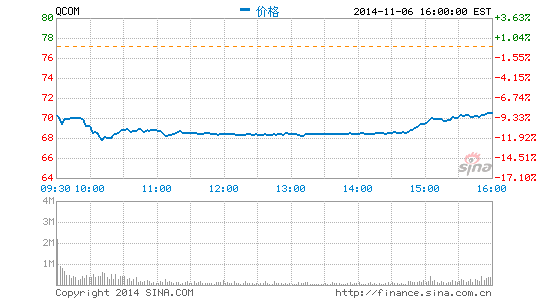
Due to some Chinese manufacturers refusing to pay royalties, the world's largest mobile phone chip maker Qualcomm (70.57, -6.63, -8.59) expects full-year profits, and revenue next year, to fall short of analyst estimates.
Qualcomm said that the US Federal Trade Commission (FTC) and the European Commission have commenced investigations into matters regarding Qualcomm's licensing and processor chip business. The investigations were disclosed along with its Q4 fiscal report. The company has also been under investigation in China by antitrust regulators.
Qualcomm CEO Steve Mollenkopf faces enormous challenges in China, the world's largest wireless market, despite the rapid growth his company has achieved here. Due to Chinese government investigations, some domestic mobile phone manufacturers are prolonging licensing negotiations and even refusing to pay licensing fees, an important source of Qualcomm's profits.
"The licensing issue has taken everyone by surprise," said Mike Walkley, an analyst at Canadian investment bank Canaccord Genuity.
In their disclosure, Qualcomm said that the purpose of the FTC probe was to determine if Qualcomm had acted in violation of principles of "fair, reasonable and non-discriminatory" practice. The inquiry in the EU, currently at a preliminary stage, is focussed on the company's broadband chip business-related rebates and financial incentives.
Falling Shares
Qualcomm shares rose less than 1 percent on Wednesday, closing at USD $77.20, and fell 6.5 percent during after-hours trading. The stock has risen 4 percent this year.
Excluding some costs, the company expects earnings per share this quarter to range from 1.18 to 1.30 US dollars, generating revenue from 6.6 to 7.2 billion. Bloomberg analysts were more optimistic, projecting earnings per share to average $1.43 this quarter, and revenue at $7.38 billion.
Looking to the end of Q3 2015, Qualcomm anticipates a net profit of USD $4.33 to $4.63 per share, with revenue at USD $26.8 to $28.8 billion. This falls short of analysts' estimates: full-year earnings at $4.89 per share and a revenue of $29.1 billion.
Business Licensing
While China upgrade its ICT standards and develops LTE networks, Mollenkopf has been attempting to expand his company's dominance of high-speed Internet phone chip markets into the world's most populous country.
One factor of this dominance is the considerable portion of its profits accruing from its patent-licensing business. Most modern phone systems use Qualcomm standards, hence Qualcomm can collect royalties based on the number of sales made by related mobile phone handset manufacturers.
China's National Development and Reform Commission began its antitrust investigation in November 2013, from which time no findings have been announced, though proceedings continue to mire business—a gripe common among foreign enterprises in China. The NDRC has now also begun looking into Qualcomm's licensing business.
"In 2015 a lot of it is about the uncertainty in China, and that's affected our guidance range," Mollenkopf told Bloomberg.
Chipping Away At Revenue
On November 6, Qualcomm reported its Q4 earnings (ending September 28). The company's net profit increased to $1.89 billion, equivalent to earnings per share of $1.11. Revenue rose 3.3 percent to $6.69 billion. Analysts on average expected earnings per share of $1.16 and revenue of $7.02 billion.
Although majority profits are derived from Qualcomm's technology licensing, most revenue comes from the modem and processor chips used in mobile phones.
Since Qualcomm has patents on CDMA technologies, even if phone manufacturers do not use Qualcomm chips, mobile phone sales still generate profits for Qualcomm. Most of today's modern, data- and network-accessing phones rely on CDMA technology--though China Mobile is a big exception as its technology does not fall under Qualcomm patents.
US market research firm IDC showed that, as of the third quarter of this year, Xiaomi is now the world's third-largest smartphone vendor. Xiaomi's shipments have more than doubled, reflecting the importance of domestic Chinese markets. In the same quarter, Lenovo handset shipments grew 38 percent. Even still, Lenovo has fallen behind Xiaomi and consequently ranks fourth in the world. The IDC said that the global smartphone market experienced an overall increase of 25% in Q3.
"From an end-market standpoint it's a very positive picture," said Qualcomm President Derek Aberle. "We feel very good about the end-market demand."
(Source)
本内容由作者授权发布,观点仅代表作者本人,不代表虎嗅立场。
如对本稿件有异议或投诉,请联系 tougao@huxiu.com。
如对本稿件有异议或投诉,请联系 tougao@huxiu.com。