



2025-12-31 20:34

扫码打开虎嗅APP



本文来自微信公众号: 城读 ,作者:CityReads,原文标题:《CityReads in 11 Years: Another Bead on the String》
On November 21,2014,the first issue of CityReadswaspostedon WeChat Public Account.On November 21,2025,the 577th issue was released—marking exactly 11 yearsof anniversary.Back then,I didn't realize it;I was simply following my habit ofwritingapostevery Friday.Creating CityReadsis like stringing beads:even though the strand often ends up crooked and uneven,I've still managed to complete this year's section.
This year,I am grateful for the companionship of my readers.Wishing everyone a happy and healthy New Year!In its 11th year,I want to express my deep gratitude to Zhang Yiting and Li Xuran for taking turnsdoingthe job offormattingeach post on WeChat Platform,especially for accommodating my increasingly late working hours.Almost every week,the images and textsI send for formatting arrive in a frantic,last-minute rush.
The biggest change in reading and writing this year has been the astonishing speed and scale of AI's penetration into human reading and writing—and ChatGPT has only been around for three years.Since its release in November 2022,it has already been used by 10%of the world's adult population.
On February10,2024,OpenAI CEO Sam Altman wrote on X(formerly Twitter):"OpenAI now generates 100 billion words per day.All people on earthgenerate about 100 trillion words per day." This means the total volume of text produced by all of humanity each day is roughly 1,000 times greater than that of OpenAI.
Modern humans emerged around 250,000 years ago,yet it wasn't until about five or six thousand years ago that writing was invented—an innovation that profoundly transformed human civilization.Today,AI has become one of the largest producers of text in the world.
A recent paper titled How People Use ChatGPT analyzed user interactions with ChatGPT from November 2022 to July 2025 and found that the three most common themes were "Practical Guidance," "Seeking Information," and "Writing",which together accounted for nearly 80%of all conversations.In work-related conversations in particular,"writing" was the primary purpose:as of June 2025,it averaged 40%of all work-related dialogues.Approximately two-thirds of all writing-related conversations involved asking ChatGPT to modify user-provided text(e.g.,editing,critiquing,translating,etc.)rather than creating new text from scratch.
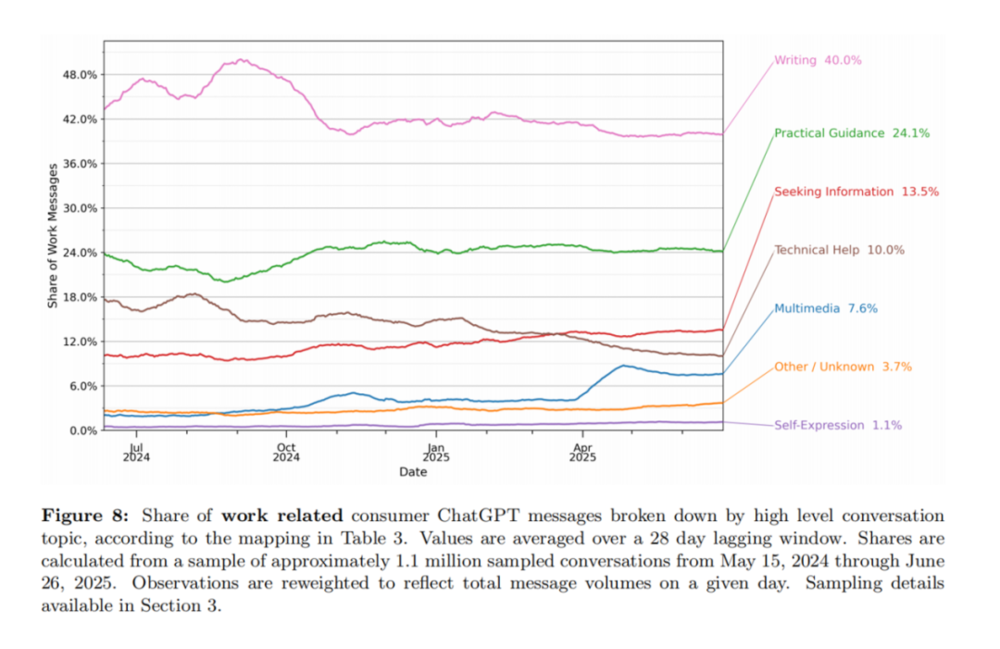
Source:https://doi.org/10.3386/w34255
From the perspective of individual impact,handing over writing entirely to AI may be convenient and fast,but it carries a potentially enormous hidden cost:it deprives humans of cognitive development that is essential to the individual.A recent MIT paper titled Your Brain on ChatGPT points out that over-reliance on artificial intelligence for writing leads to so-called "cognitive debt." By outsourcing thinking tasks that the brain should perform itself,it negatively affects multiple brain functions—for example,the hippocampus stops encoding memories(preventing the formation of new memories),the prefrontal cortex becomes almost inactive(the region responsible for planning),and the anterior cingulate cortex also grows less active(a key area for thinking and judgment).
From a societal perspective,American venture capitalist and programmer Paul Graham predicts that in a few decades,few people will know how to write.Writing will become the privilege of a minority,splitting society into a world of "writes" and "write-nots," with the middle ground—those who write moderately well—disappearing.Because writing is thinking,the consequences of this divide between "writes" and "write-nots" are actually far more serious than they sound:society will split into "thinks" and "think-nots".
In another essay,The Need to Read,Graham discusses the importance of writing for thinking:"A good writer doesn't just think,and then write down what he thought,as a sort of transcript.A good writer will almost always discover new things in the process of writing.And there is,as far as I know,no substitute for this kind of discovery.Talking about your ideas with other people is a good way to develop them.But even after doing this,you'll find you still discover new things when you sit down to write.There is a kind of thinking that can only be done by writing.”
Graham notes that the societal stratification brought by such technological change is not new.In the pre-industrial era(especially the hunter-gatherer period),survival depended primarily on physical strength;those who were not strong could not find food.In post-industrial society,where sedentary office-based mental labor dominates,people have become physically weaker.To stay physically strong,one must deliberately go to the gym to exercise muscles.The same applies to writing:if we over-rely on AI for writing,the brain will atrophy,and we will need to deliberately practice the "muscles" of thinking through writing.Writing is the gym for the brain.
Science fiction writer Ted Chiang uses a similar metaphor:he says that "Using ChatGPT to complete assignments is like bringing a forklift into the weight room;you will never improve your cognitive fitness that way."
Though I cannot read and write as much or as quickly as AI,I still choose to use my own clumsy brain—to read slowly,think laboriously,and write bit by bit,painstakingly and time-consumingly.Of course,I do use AI in reading and writing—for example,for basic translation work or to help refine word choices—but I will not ask AI to extract key points from papers or books.Perhaps my use of AI is limited,but AI-generated reading summaries feel too generic and superficial,missing many details;it's like chewing sugarcane pulp.Nor will I ask AI to provide writing ideas or outlines—that is something I must do myself.
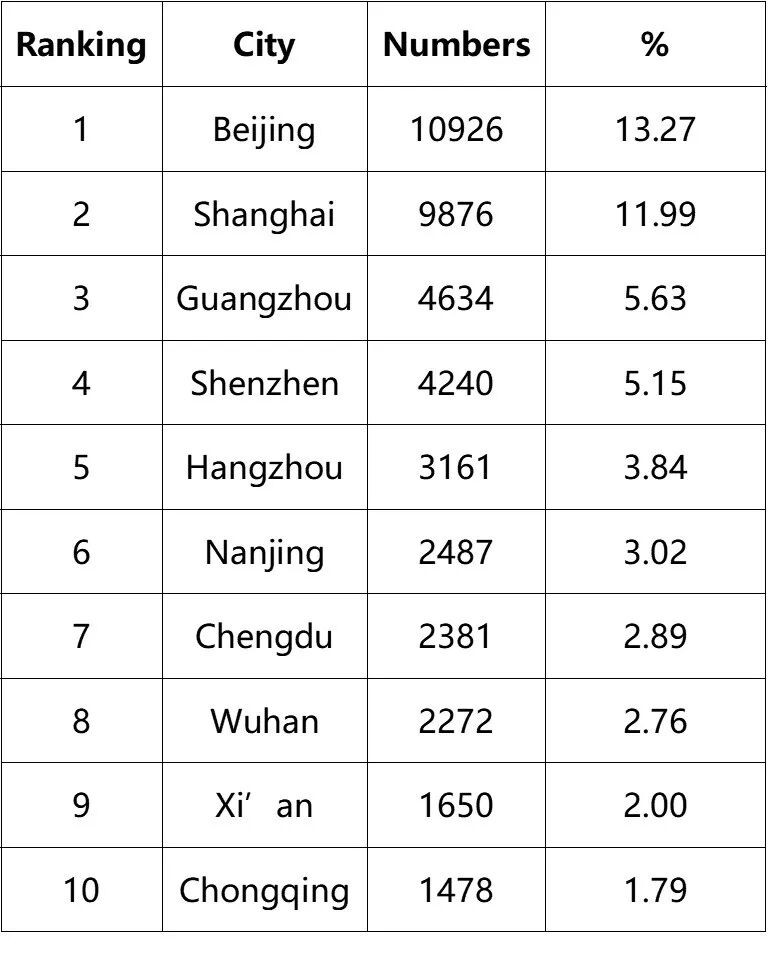
As of now,CityReads has approximately 82,000 subscribers(see Figure 1).According to WeChat public account platform statistics,the number of regular readers stands at 6,658,accounting for 8%.The gender ratio among subscribers is 45:55(male to female).The geographic distribution of subscribers continues to follow a "tale of two cities"pattern:Beijing and Shanghai together account for 25%of subscribers,while thesubscribersin Guangzhou and Shenzhen are each less than half of those in Beijing or Shanghai.The next six cities in order are Hangzhou,Nanjing,Chengdu,Wuhan,Xi'an,and Chongqing.
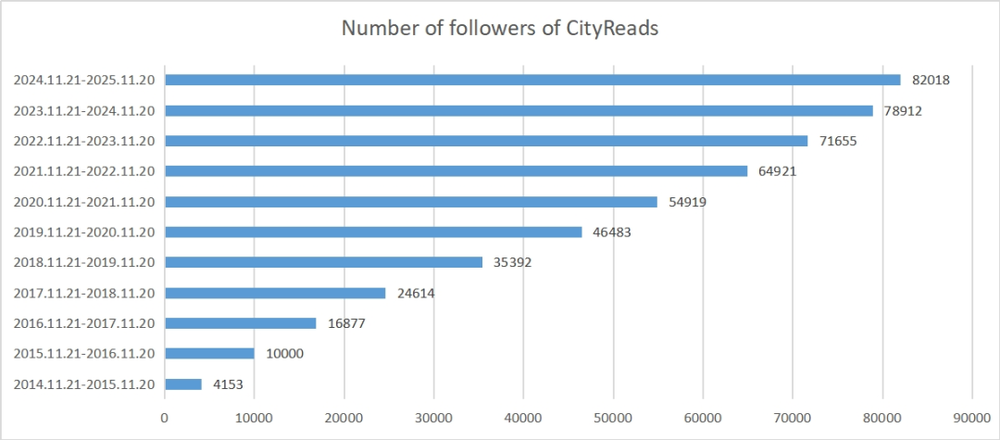
Figure 1 Number of followers of CityReads
Table 1City distribution of the followers of CityReads
This year's growth in subscriber numbers has been the lowest in the 11-year history of CityReads,and the number of regular readers has also declined compared to last year.With the exception of a fewposts that touched on hot social topics,the readership of mostposts has dropped sharply compared to the previous year.Surprisingly,however,several data-driven articles analyzing Chinese society this year performed relatively well in terms of views(CityReads|Execute Line vs.Poverty Line;CityReads|China Trains the Most Engineers;CityReads|Save Boys or Save Girls?;CityReads|How Has Trade changed the Chinese economy).
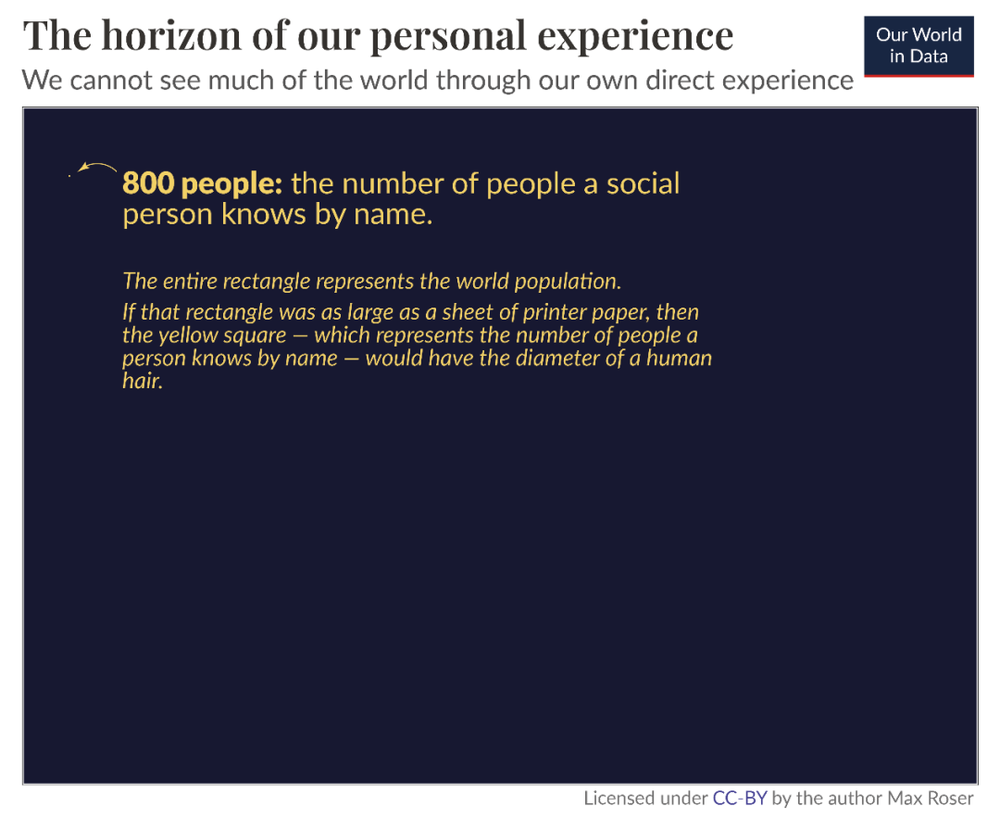
CityReads has remained a highly niche public account after 11 years.For example,CityReads subscribers in Shanghai represent only 0.04%of the city's permanent population—just four in ten thousand.Yet those 9,876 subscribers in Shanghai alone already far exceed the upper limit of one individual can personally know.According to a U.S.study titled How Many People Do You Know?,Americans on average know 611 people.Even if you are more sociable than the average American and know 800 people,in a world of 8 billion,that means you know just 0.00001%of the population—one in ten million.
Fortunately,beyond direct interpersonal interaction,we have many other ways to understand the world:through reading,through data,through multimedia.These allow us to continually broaden our knowledge of the world.I will continue reading,thinking,and writing with my own mortal mind and body—even if my abilities are limited,even if my thoughts and analyses are not fully mature,even if the strand of beads I string together is crooked and uneven.
Picture source:Malcesine on Lake Garda,1913 by Gustav Klimt