


2026-02-23 20:10

扫码打开虎嗅APP


本文来自微信公众号: IPP评论 ,作者:梅里·马达沙希,原文标题:《梅里·马达沙希|冰融北极:地缘政治竞争与全球秩序的脆弱性》
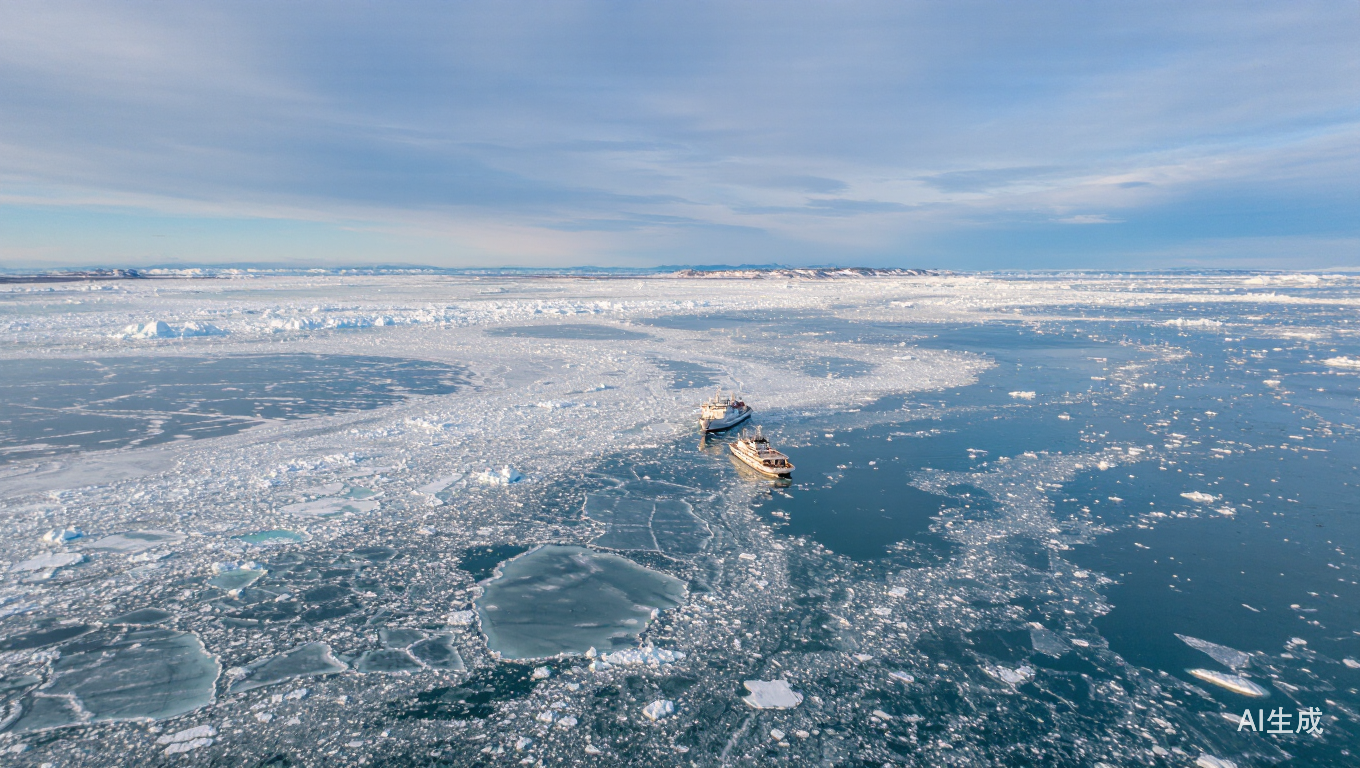
在成为地缘政治博弈的舞台之前,北极长期以来一直是地球生命体系的重要稳定器。其广袤的冰盖将太阳辐射反射回太空,从而调节全球气温;其寒冷的海水帮助维持温盐环流,影响跨洲际的天气系统;其永久冻土层则封存着数千年来积累的大量碳储量。
Long before it became a theatre of geopolitical calculation,the Arctic was a stabilizer of life on Earth.Its vast ice sheets reflect solar radiation back into space,moderating global temperatures.Its cold waters help regulate thermohaline circulation,influencing weather systems across continents.Its permafrost has locked away immense quantities of carbon accumulated over millennia.
从历史上看,这一地区深刻塑造了大气平衡、海平面变化以及生物多样性的格局。原住民社会适应了其严酷却相对稳定的自然节律。全球气候的整体均衡,在一定程度上依赖于其冰冻状态的持续存在。
Historically,the region has shaped atmospheric balance,sea levels,and biodiversity patterns.Indigenous communities adapted to its harsh but stable rhythms.Global climatic equilibrium depended,in part,on its frozen continuity.
如今,这种稳定性正在消蚀。加速融冰、气温上升与生态系统紊乱,正以前所未有的速度改变这一脆弱环境。所谓“北极放大效应”——即该地区升温速度超过全球平均水平两倍以上的现象——正在削弱冰雪反照率效应,加速永久冻土解冻,并破坏生态系统稳定。随着冰层消退,深色海面吸收更多热量;解冻土壤释放出甲烷和二氧化碳;大量淡水流入改变海洋盐度与环流结构。
Today,that stability is eroding.Accelerated ice melt,rising temperatures,and ecological disruption are transforming this fragile environment at an unprecedented pace.Arctic amplification,the phenomenon by which the region warms at more than twice the global average-is disrupting ice albedo effects,accelerating permafrost thaw,and destabilizing ecosystems.As ice disappears,darker ocean surfaces absorb more heat.Methane and carbon dioxide are released from thawing soils.Freshwater influx alters ocean salinity and circulation.
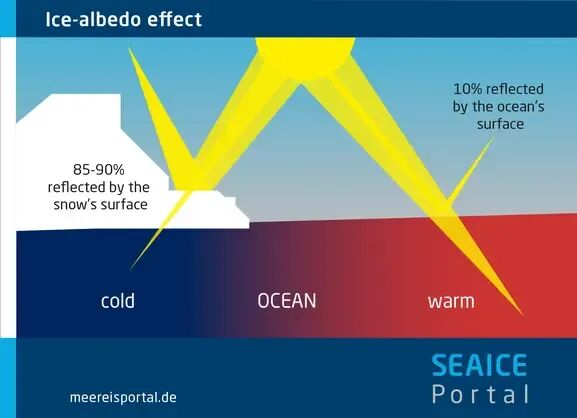
海冰在地球能量收支中的作用。在高反照率情况下,雪面能反射85-90%的太阳辐射,使下方保持寒冷;在低反照率下,海洋表面仅反射约10%的光线而吸收大部分热量,导致海水变暖。(图源:Meereisportal)
这些变化并非单纯自然周期所致,而是与人类活动引发的全球变暖、工业扩张以及长期气候治理不足密切相关。北极,这一曾被视为遥远而冰封的边缘地带,已迅速成为21世纪最具深远影响的地区之一。
These changes are not the result of natural cycles alone.They are closely linked to human-induced global warming,industrial expansion,and decades of insufficient climate governance.The Arctic,once perceived as a distant and frozen periphery,has rapidly emerged as one of the most consequential regions of the twenty-first century.
当下北极所发生的一切,折射出更为深层的地球治理危机,也揭示出国际秩序日益加剧的紧张与失衡。随着冰层退缩、空间开放,主要大国正迅速行动,力图巩固战略位置、获取经济优势并建立安全支点。美国、俄罗斯、中国、欧洲国家以及加拿大,不仅越来越多地将这一地区视为环境前沿,更视其为影响力扩展、竞争博弈乃至潜在对抗的战场。
What is unfolding in the Arctic today reflects a deeper crisis of planetary stewardship.It also reveals a growing crisis of international order.As ice retreats and new spaces open,major powers are moving rapidly to secure strategic positions,economic advantages,and security footholds.The United States,Russia,China,European states,and Canada increasingly view the region not only as an environmental frontier,but as a zone of influence,competition,and potential confrontation.
因此,北极变化不能被理解为一次孤立的环境事件,而是全球数十年来经济发展模式与政治抉择累积演变的结果。不作为、短期主义思维以及薄弱的国际协调,使这一地区的气候风险在不断积聚,其上升速度已远远超过现有治理机制所能有效回应的能力。
The transformation of the Arctic,therefore,cannot be understood as an isolated environmental event.It is the cumulative outcome of economic models and political choices made over decades across the world.Inaction,short-termism,and weak international coordination have allowed climate risks to accumulate faster than governance mechanisms could respond in this region.
随着冰层消退,曾经难以进入的区域正日益向人类活动开放。新的海上航道有望缩短主要市场之间的运输距离。丰富的油气资源、稀土元素以及战略性矿产储量,正吸引着商业资本与政治力量的关注。旅游业、渔业以及基础设施建设也开始向这些生态脆弱地带延伸。
As ice retreats,previously inaccessible spaces are becoming increasingly open to human activity.New maritime routes promise shorter connections between major markets.Vast reserves of hydrocarbons,rare earth elements,and strategic minerals are attracting commercial and political interest.Tourism,fisheries,and infrastructure development are expanding into fragile zones.
因此,气候变化所带来的结果具有某种悖论性:它不仅造成了环境损失,也开辟了新的经济与军事布局空间。港口、机场、卫星设施和监测系统正在扩建或升级;海军部署与联合演习日益增多;各国的战略构想也在根据北极现实不断调整。
What climate change has,therefore,produced,paradoxically,is not only environmental loss,but also new arenas for economic and military positioning.Ports,airfields,satellite facilities,and surveillance systems are being expanded or modernized.Naval deployments and joint exercises are increasing.Strategic doctrines are being adjusted to Arctic realities.
二、气候变迁与战略重构
II.Climate Transformation and Strategic Repositioning
随着北极升温持续加速,气候变化已不再仅仅被视为环境议题,而是日益被纳入国家安全战略规划之中。
As Arctic warming accelerates,climate change is no longer treated merely as an environmental issue,buthas increasingly become embedded in national security planning.
北约态势的演进、俄罗斯对其北部边疆的安全化处理、中国不断扩展的科研与后勤布局,以及各类相互竞争的经济项目,正在重塑该地区的力量格局。
NATO’s evolving posture,Russia’s securitization of its northern frontier,China’s expanding scientific and logistical presence,and competing economic projects are reshaping the regional balance.
形成中的大国竞争并不仅限于军事领域,还延伸至法律主张、投资流动、科学合作、数据控制以及制度性影响力等多个层面。
The emerging rivalry among powers is not only confined to military affairs,but it also extends to legal claims,investment flows,scientific cooperation,data control,and institutional influence.
对于美国而言,北极已成为导弹预警体系、太空监测系统以及跨大西洋防务架构中的关键枢纽。格陵兰——近期争议讨论的焦点之一——位于北美与欧洲之间的战略要冲,这一地缘位置进一步强化了华盛顿巩固其战略存在的意图。
For the United States,the Arctic has become central to missile warning systems,space surveillance,and transatlantic defence architecture.Greenland—as a center of contentious discussions recently—occupies a pivotal position between North America and Europe,reinforcing Washington’s interest in consolidating its strategic presence.
俄罗斯将北极视为其核心国家安全前沿。近年来,其不断扩建军事基地,升级破冰船队,并将北方航道纳入国家防务与经济战略体系之中。对莫斯科而言,“高北地区”(High North)既是战略纵深所在,也是重要的地缘政治筹码。
Russia treats the Arctic as a core national security frontier.It has expanded military bases,modernized icebreaker fleets,and integrated the Northern Sea Route into its defence and economic strategy.For Moscow,the High North represents both strategic depth and geopolitical leverage.
中国自我定位为“近北极国家”,并通过“极地丝绸之路”框架,加强科研考察、物流布局与商业参与。这些活动虽以民用性质加以表述,但在西方语境中,往往被置于体系性竞争的视角加以解读。
China,defining itself as a“near-Arctic state,”has intensified scientific missions,logistics development,and commercial engagement through its Polar Silk Road framework.These activities,while framed as civilian,are widely interpreted in the West through the lens of systemic rivalry.
加拿大及北欧国家加强了主权巡逻、监测体系与北部基础设施建设。北约演习也日益纳入北极情境,显示出该地区正被系统性整合进联盟的安全规划之中。
Canada and Nordic states have strengthened sovereignty patrols,surveillance systems,and northern infrastructure.NATOexercises increasingly incorporate Arctic scenarios,reflecting the region’s integration into alliance security planning.
在这一不断演变的背景下,气候变化正发挥着“战略加速器”的作用。它压缩了战略博弈的时间窗口,加剧了竞争态势,也削弱了地理环境曾经提供的缓冲空间。
In this evolving context,climate change functions as a strategic accelerator.It compresses timelines,intensifies competition,and weakens the buffer once provided by geography.
如果当前趋势持续下去,北极有可能沦为又一个由碎片化治理与权力政治主导、集体责任被边缘化的博弈场域。
If current trends continue,the Arctic risks becoming another arena in which fragmented governance and power politics override collective responsibility.
北极已不再只是一个持续升温的地区,而正逐步演变为战略重构的核心场域。与此同时,那些为低紧张时期而设计的北极治理机制,正日益受到互不信任与地缘政治外溢效应的冲击与挤压。
The Arctic is no longer merely warming;it is becoming a central arena of strategic repositioning,and Arctic governance mechanisms,designed for an era of low tension,are increasingly strained by mistrust and geopolitical spillovers.
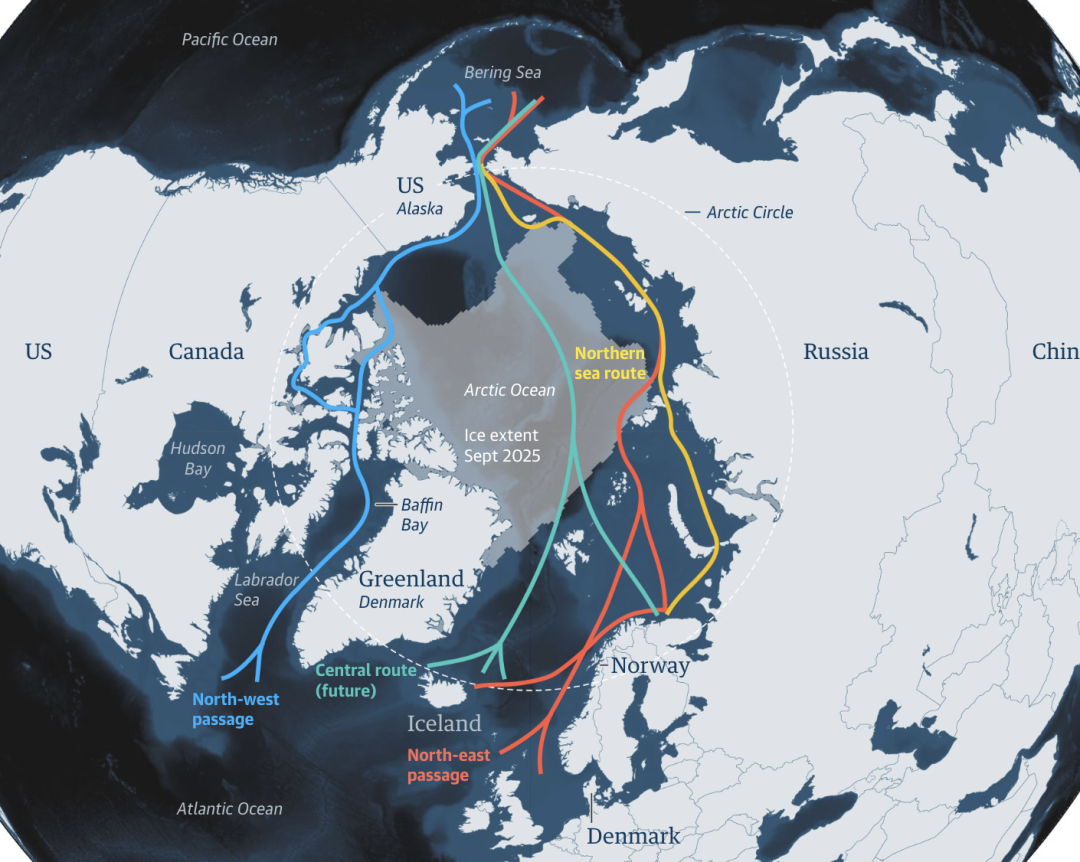
北极地区的主要航运路线图。图源:英国卫报
三、格陵兰问题与联盟治理的压力
III.Greenland and the Strain on Alliance Governance
近年来,格陵兰已成为美国高度关注的硬战略焦点。格陵兰位于北大西洋、北冰洋以及北美与欧洲大陆交汇处的关键地缘位置。其区位使其成为早期预警系统、导弹防御基础设施、太空与空域监测体系的重要枢纽,同时也是控制GIUK(格陵兰—冰岛—英国)海军缺口的关键节点——这一通道是跨大西洋海军行动与核威慑体系中的重要战略咽喉。
In recent years,Greenland has emerged as a hard strategic focus for the United States.Greenland occupies a pivotal geostrategic location at the intersection of the North Atlantic,the Arctic Ocean,and the North American and European landmasses.Its position makes it a linchpin for early-warning systems,missile defence infrastructure,space and air monitoring,and control of the GIUK(Greenland,Iceland,UK)naval gap,a critical chokepoint for transAtlantic naval movements and nuclear deterrence.
作为丹麦王国内的自治领地,格陵兰在跨大西洋安全架构中处于高度敏感的位置。数十年来,美国的防务设施在丹麦主权与联盟合作框架下并存运行。根据美丹之间长期存在的防务安排,美军一直在格陵兰保持军事存在,尤以皮图菲克太空基地(Pituffik Space Base)为代表。然而,近年来美国领导层的政治表态已超越传统安全合作的范畴,公开主张对该岛实施直接控制甚至收购,并一度提出使其正式成为美国领土的设想。这一立场明显背离了二战后北约所确立的基本规范。
As an autonomous territory within the Kingdom of Denmark,Greenland occupies a sensitive position in transatlantic security arrangements.For decades,U.S.defence installations coexisted with Danish sovereignty and alliance cooperation.Under longstanding defence arrangements between the U.S.and Denmark,American military forces have maintained a presence in Greenland,notably at Pituffik Space Base.But recent political rhetoric by U.S.leadership has gone beyond traditional security cooperation to advocate for direct control or acquisition of the island,even floating the idea that it could become formally American territory.This is a striking departure from post-World War II NATO norms.
美国方面关于加强对基础设施与资源控制的表态,已在欧盟与北约内部引发广泛关切。
Expressions of American interest in greater control over infrastructure and resources have raised concerns within the European Union and NATO.
欧洲各国政府对此作出强烈回应。多位欧盟及北约成员国发表联合声明,强调格陵兰的未来属于丹麦及其自治当局的内部事务,并警告任何来自美国方面——即便只是言辞层面的——“接管”意图,都可能动摇联盟团结的根本基础。一些欧洲领导人更将这一争议界定为对《北大西洋公约》第五条精神的挑战。该条款规定,盟国在遭受外部侵略时应承担集体防御义务。在一种假设情境下,若美国对另一北约成员领土动用武力,集体防御的逻辑将面临最严峻的考验:第五条是否意味着欧洲需要为丹麦对抗华盛顿?欧洲官员已将这种可能性形容为联盟面临的根本性危机。
European governments have reacted sharply.Several EU and NATO members issued joint statements asserting that Greenland’s future is an internal matter for Denmark and its autonomous authorities,and warning that any attempt by the United States to seize control-even rhetorically-threatens the very foundation of alliance solidarity.Some European leaders framed this dispute as a challenge to the spirit of Article 5 of the North Atlantic Treaty,which commits allies to mutual defence against external aggression.In the hypothetical scenario of a U.S.use of force against a fellow NATO territory,the logic of collective defence would face its most extreme test:would Article 5 obligate Europe to defend Denmark against Washington?European officials have described such a possibility as a fundamental crisis for the alliance.
这些举动被广泛视为对以尊重主权与集体防御为基础的联盟规范的试探与冲击。
These moves are widely perceived as testing alliance norms based on mutual respect for sovereignty and collective defence.
这一争议亦在北约内部引发讨论,围绕如何强化欧洲防务支柱,并调整北极地区的行动构想,以确保在跨大西洋分歧加剧的背景下,战略合作不至于发生结构性松动。
The dispute has also triggered discussions within NATO about enhancing a European defence pillar and adjusting operational concepts in the Arctic to ensure that strategic cooperation does not unravel amid transatlantic disagreements.
这一问题所牵涉的,远不止一场双边分歧。格陵兰争议所暴露的,是西方安全架构内部更深层次的张力——即合作式治理与单边战略算计之间的结构性矛盾。
At stake is more than a bilateral disagreement.The Greenland issue exposes a deeper tension within Western security arrangements:between cooperative governance and unilateral strategic calculation.
如果联盟成员以牺牲伙伴利益为代价追求领土或基础设施优势,集体防御框架的可信度势必受到削弱。建立在信任与互惠基础之上的第五条逻辑,也将更容易受到政治层面的重新诠释与动摇。
If alliance members pursue territorial or infrastructural advantage at the expense of partners,the credibility of collective defence frameworks is weakened.The logic of Article 5,built on trust and reciprocity,becomes vulnerable to political reinterpretation.
因此,格陵兰问题生动地表明,气候驱动下的战略重构如何可能动摇既有制度基础。环境变化在开启新的物理空间的同时,也在对合作所依托的政治架构施加持续压力。
Greenland thus illustrates how climate-driven strategic repositioning can destabilize institutional foundations.Environmental change is opening physical space while placing stress on the political architecture of cooperation.
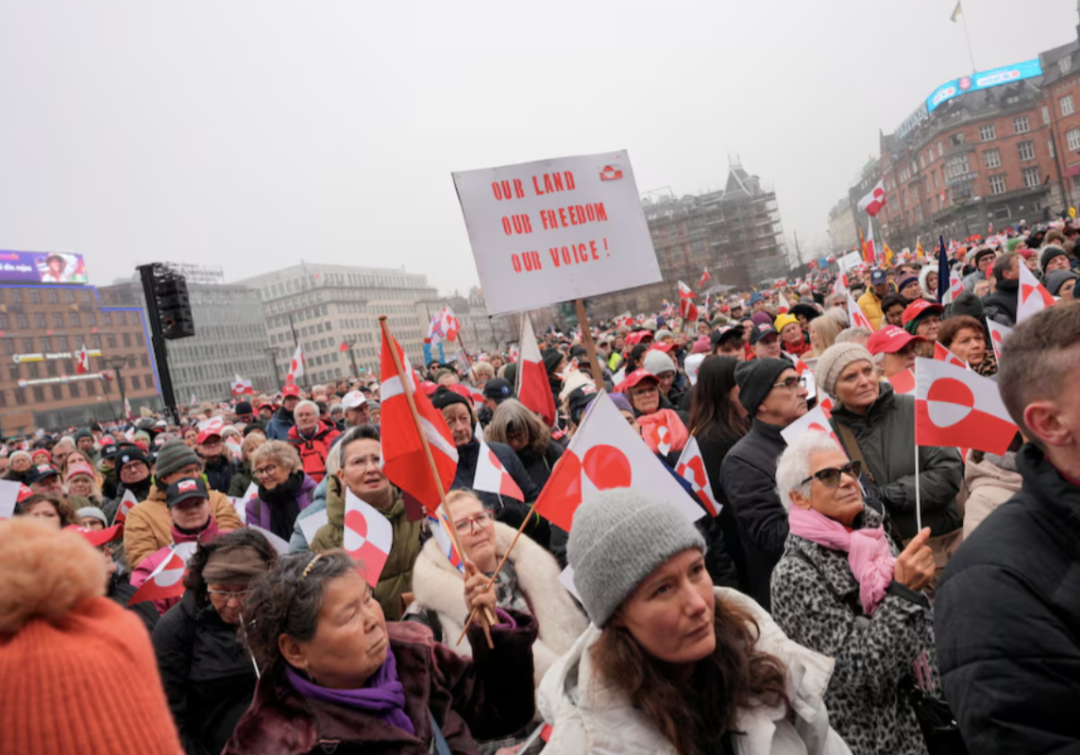
2025年3月15日,格陵兰民众在努克美国领事馆前举行抗议活动。图源:美联社
四、人类所面临的直接与长期影响
IV.The Immediate and Long-Term Human Consequences
正如本文所指出的,气候变化所带来的结果具有某种悖论性:它不仅造成环境损失,也催生了新的经济与军事布局空间。港口、机场、卫星设施和监测系统正在扩建或升级;海军部署与联合演习不断增加;各国战略构想也在根据北极现实进行调整。
As we argued in this article,climate change has produced,paradoxically,not only environmental loss,but also new arenas for economic and military positioning.Ports,airfields,satellite facilities,and surveillance systems are being expanded or modernized.Naval deployments and joint exercises are increasing.Strategic doctrines are being adjusted to Arctic realities.
环境退化由此被转化为地缘政治博弈中的战略筹码。
Environmental degradation has thus been translated into geopolitical leverage.
对航道、资源与物流枢纽的获取,已不再仅由地理条件决定,而是越来越取决于技术能力、资本实力与政治站位。能够在极端环境中开展行动的国家,将获得不成比例的战略优势;而其他国家则面临被边缘化的风险。
Access to routes,resources,and logistical hubs is no longer determined by geography alone,but by technological capacity,financial strength,and political alignment.States capable of operating in extreme conditions gain disproportionate advantages.Others risk strategic marginalization.
在这一背景下,北极正被重新界定——不再是人类共享的生态遗产,而是一个充满竞争与博弈的战略空间。
In this context,the Arctic is being redefined-not as a shared ecological heritage-but as a contested strategic space.
近期的科学研究与调查性报道表明,北极融化已不再是抽象的风险预警,而正在引发一系列系统性变化,威胁水资源安全、生态系统稳定、经济秩序以及人类健康。
Recent scientific research and investigative reporting reveal that Arctic melting is no longer an abstract risk.It is triggering systemic changes that threaten water security,ecosystems,economic stability,and human health.
过去十年是北极有记录以来最为温暖的十年。根据美国国家海洋和大气管理局(National Oceanic and Atmospheric Administration)的数据,2025年冬季海冰面积降至历史最低水平。与此同时,欧盟观测计划“哥白尼”(Copernicus)警告称,全球气温升至1.5°C的时间点可能早于此前预期。这种加速趋势反映出化石燃料排放的持续增长,以及国际气候协调机制的薄弱。
The past decade has been the warmest on record in the Arctic.Winter sea ice reached historic lows in 2025,according to National Oceanic and Atmospheric Administration.Meanwhile,the European Union’s observation programme Copernicus,warns that global temperatures are approaching 1.5°C earlier than anticipated.This acceleration reflects continued growth in fossil fuel emissions and weak international climate coordination.
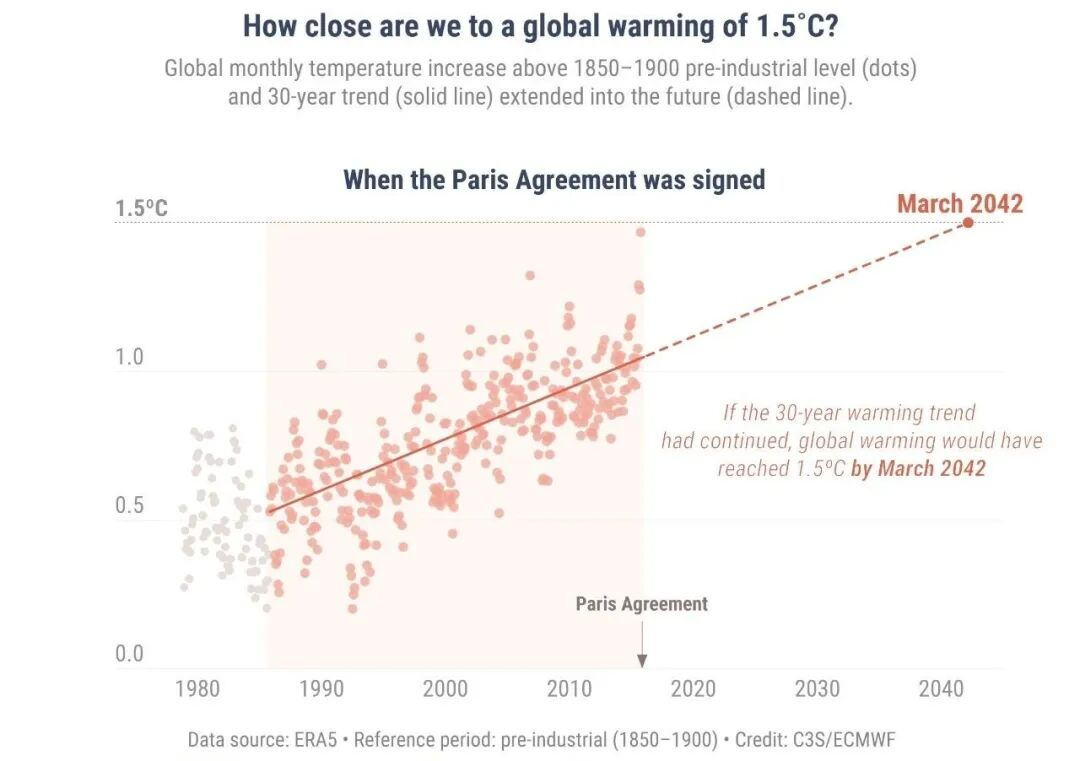
哥白尼气候观策计划的数据显示,2015年12月《巴黎协定》签署时,1.5°C的升温阈值将在2042年3月达到。2025年末在协定签署十周年之际,该计划预测,这一目标将在2029年5月达到。图片:哥白尼计划
其中最令人警惕的后果之一,是淡水系统的退化。
One of the most alarming consequences is the degradation of freshwater systems.
在阿拉斯加的布鲁克斯山脉(Brooks Range),由于永久冻土融化将铁、锰、镍和铝等元素释放进入水体循环,已有超过200条河流呈现锈橙色。阿拉斯加费尔班克斯大学(University of Alaska Fairbanks)参与的研究证实,这一被称为“锈河”(rusting river)的现象,正是由气候变化所驱动。随着永久冻土解冻,数千年来被冻结的矿物质与有机物开始发生化学活化;当其暴露于氧气和酸性水体环境中时,便引发一系列化学反应,将金属元素淋滤并输送进入河流系统。
In Alaska’s Brooks Range,more than 200 rivers have turned rust-orange as thawing permafrost releases iron,manganese,nickel,and aluminium into circulation.Research involving the University of Alaska Fairbanks confirms that this“rusting river”phenomenon is driven by climate change.As permafrost thaws,minerals and organic matter that were frozen for millennia become chemically active.Exposure to oxygen and acidic water triggers reactions that leach metals into river systems.
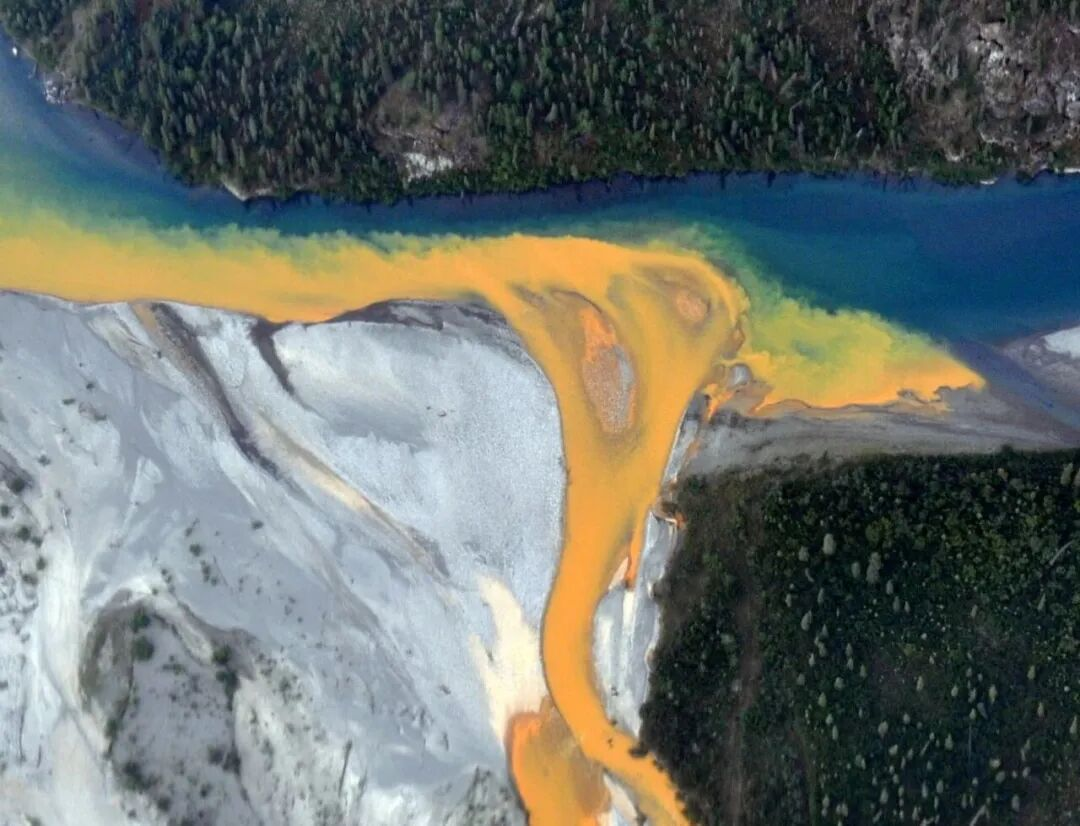
阿拉斯加北极之门国家公园库图克河的河水呈锈红色。融化的永久冻土使矿物质暴露在风化作用下,导致河水酸度升高,并释放出铁、锌和铜等金属。(美国国家公园管理局)
一旦激活,这些化学过程在事实上几乎不可逆转。
Once initiated,these chemical processes are effectively irreversible.
类似的变化也正在欧洲多处山区显现,包括阿尔卑斯山和比利牛斯山脉,这表明更为广泛的地球化学失衡正在发生。
Similar transformations are emerging in mountain regions across Europe,including the Alps and Pyrenees,signalling broader geochemical disruption.
永久冻土的融化还会释放大量温室气体。伍德韦尔气候研究中心(Woodwell Climate Research Center)的研究人员指出,解冻土壤中的微生物活动会形成反馈循环,从而进一步加速全球变暖进程。
Permafrost thaw also releases massive quantities of greenhouse gases.According to researchers at the Woodwell Climate Research Center,microbial activity in thawing soils creates feedback loops that accelerate warming.
北极研究所(The Arctic Institute)的估算显示,全球永久冻土中蕴含的碳储量高达1.7万亿吨——约为2024年全球各国碳排放总量的45倍。即便其中仅有部分释放,也可能从根本上动摇现有气候减缓努力的基础。
Estimates by The Arctic Institute suggest that global permafrost contains up to 1.7 trillion tonnes of carbon-roughly forty-five times the total emissions produced by all countries in 2024.If released even partially,this reservoir could fundamentally destabilize climate mitigation efforts.
对于北极地区的社区而言,这些变化已开始转化为深刻的社会与经济冲击。饮用水受到污染,建筑物发生坍塌,海岸侵蚀迫使居民迁移;以狩猎、捕鱼和季节性迁徙为基础的传统生计方式日益受到侵蚀。
For Arctic communities,these changes are already translate into social and economic disruption.Drinking water become contaminated.Building collapse.Coastal erosion forces relocatation.Traditional livelihoods based on hunting,fishing,and seasonal migration are increasingly undermined.
据估计,到2100年,近地表永久冻土可能大范围消失。这将加剧野火、洪涝、地面塌陷以及极地地区的基础设施失效。
It is estimated that,by 2100,near-surface permafrost may largely disappear.This would intensify wildfires,flooding,land collapse,and infrastructure failure across polar regions.
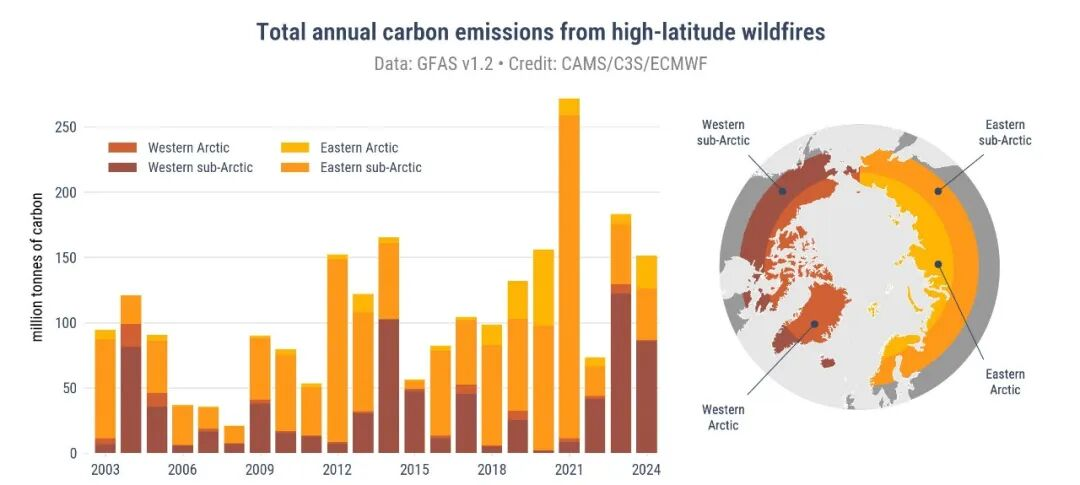
2003年至2024年北半球高纬度地区(北纬60°以北)所有陆地野火造成的年度碳排放总量估算值(百万吨)。颜色代表排放区域。(右图)地图显示了四个区域:西部亚北极(深棕色)、西部北极(浅棕色)、东部亚北极(深橙色)和东部北极(浅橙色)。图源:哥白尼计划
正在发生的,并不仅仅是环境退化,而是人类栖居空间的缓慢瓦解。
What is unfolding is not simply environmental degradation.It is the slow dismantling of human habitats.
更为广泛地看,科学家警告称,一旦跨越关键气候临界点,地球系统可能发生不可逆转的变化,从而危及全球经济增长、粮食安全与公共健康。
More broadly,scientists warn that crossing critical climatic thresholds could trigger irreversible changes across Earth’s systems,endangering economic growth,food security,and public health worldwide.
北极,已然成为全球风险的“放大器”。
The Arctic has become a global risk multiplier.
五、治理、秩序与未来
V.Governance,Order,and the Future
正如本文此前所指出的,北极理事会及现有治理机制原本是在地缘政治紧张程度较低的时代背景下设计的。而如今,政治极化、制裁对抗以及战略互疑,正对这些制度框架构成持续性的压力。
As was mentioned earlier in this article,the Arctic Council and existing governance mechanisms were designed for an era of low geopolitical tension.Today,polarization,sanctions,and strategic mistrust strain these frameworks.
环境治理日益让位于安全考量;科学合作被政治化;透明度不断下降。
Environmental management is increasingly subordinated to security calculation.Scientific cooperation is politicized.Transparency declines.
如果竞争压倒责任,北极可能沦为又一个碎片化治理的场域,映射出国际体系更为广泛的结构性裂痕。
If rivalry overtakes responsibility,the Arctic may become another arena of fragmented governance,reflecting wider fractures in the international system.
然而,另一条路径仍然存在。
Yet another path remains possible.
北极完全可能成为重塑多边主义的试验场——在共同规则之下,将气候减缓、原住民权利、安全透明与可持续发展加以整合。
The Arctic could become a laboratory for renewed multilateralism-integrating climate mitigation,indigenous rights,security transparency,and sustainable development under shared rules.
真正的抉择,并非发展与保护之间的对立,而是在短期竞争与长期地球稳定之间作出选择。
The choice is not between development and preservation.It is between short-term competition and long-term planetary stability.
结语:对全球成熟度的考验
Conclusion:A Test of Global Maturity
北极的融化,并非单纯的区域性变迁,而是一场检验——检验人类能否在权力政治与生态边界之间实现真正的调和。
The melting Arctic is not merely a regional transformation.It is a test of whether humanity can reconcile power politics with ecological limits.
如果气候失序成为军事化与大国竞争的催化剂,其后果将远远超出北极圈本身。然而,若各国能够认识到,北极的稳定本质上支撑着全球体系的稳定,那么合作仍有可能占据上风。
If climate breakdown becomes an accelerant of militarization and rivalry,the consequences will extend far beyond the polar circle.If,however,states recognize that Arctic stability underpins global stability,cooperation may yet prevail.
北极正处于地球生命支持系统与地缘政治雄心交汇的节点。
The Arctic stands at the intersection of life-support systems and geopolitical ambition.
北极将如何被治理,将深刻揭示当下正在成形的世界秩序的走向与性质。
How it is governed will reveal much about the world order now taking shape.