2026-03-18 19:05

本文来自微信公众号: SCOTTHYOUNG ,作者:斯科特·扬,原文标题:《聪明的人如何决定何时该放弃——放弃前,先问自己这四个问题》
很多建议都在告诉你该做什么,但关于「该放弃什么」的建议却少之又少。每一条走过的路,都意味着另一条路被放弃,两者同等重要。
In some ways,choosing to quit is harder than choosing to take action.We all know we should exercise,read,meditate,socialize,work hard,spend time with family,and drink eight glasses of water every day.But when that list inevitably becomes unmanageable,it's hard to say what we ought to stop.
某种程度上,决定放弃比决定行动更难。我们都知道应该锻炼、阅读、冥想、社交、努力工作、陪伴家人、每天喝八杯水。但当这份清单不可避免地变得无法管理时,我们却很难说清楚该停下哪件事。
Another reason the importance of quitting is less often discussed is that worthwhile pursuits are often challenging,and it is tempting to surrender to early difficulties."Never give up" is an unrealistic slogan,but it may serve us well in situations where we're tempted to give up on our dreams and watch Netflix instead.
「放弃」之所以较少被讨论,还有另一个原因:有价值的事往往充满挑战,人们很容易在遇到早期困难时就想放弃。「永不放弃」是个不切实际的口号,但在我们想要抛下梦想去刷剧的时候,它确实能派上用场。
Because we devote more time to thinking about projects we should undertake rather than those we should abandon,the latter tends to occur impulsively.We quit because we're tired,bored,or because something else seems more appealing.I think this is a mistake.Thinking more deliberately about when to give up might improve our decisions more than simply choosing more tasks to add to our to-do list.
因为我们花在「该做什么」上的时间,远多于「该放弃什么」,所以放弃往往是冲动之举。我们放弃,是因为疲惫、无聊,或者因为别的事情看起来更诱人。我认为这是个错误。认真思考何时该放弃,也许比不断往待办清单上添加新任务更能改善我们的决策。
Here are four questions you can ask yourself to help make the decision.
以下四个问题,可以帮助你做出更好的判断。
1.The past is done.Do the future benefits outweigh the future costs?
1.过去已成定局。未来的收益是否大于未来的成本?
It's often helpful to start with figuring out what an ideally rational person would do in your situation.If you could consult an oracle who never gets tired or frustrated,and could calculate the right decision,what would she tell you to do?
一个好的起点,是想象一个理想中完全理性的人会怎么做。如果你能请教一位永不疲惫、永不沮丧、能精确计算出最优解的智者,她会给你什么建议?
Oracles don't exist,so we'll have to settle for economic theory.A key concept is sunk costs.This is the idea that when making a decisionin the present moment,past investments don't matter.All that matters is how much you anticipate investing in the future,and whether those investments will pay off.
智者并不存在,所以我们只能借助经济学理论。其中一个关键概念是「沉没成本」。它的核心思想是:在当下做决策时,过去的投入已经不重要了。唯一重要的,是你预计未来还需要投入多少,以及这些投入是否值得。
Suppose you've invested three years working toward an accounting degree in college.But if you could go back,you'd study engineering instead.Should you quit accounting and switch majors or stick it out?
假设你已经花了三年攻读会计学位,但如果可以重来,你会选择读工程专业。那么,你应该放弃会计、转换专业,还是坚持下去?
It's tempting to analyze this decision by considering it as a whole:"Do I want to study accounting or engineering?" But this isn't correct.The better question is "Will it be better for me to invest one more year and get an accounting degree,or switch immediately and start four years studying engineering?"
人们往往会把这个问题整体来看:「我到底想学会计还是工程?」但这样问是错误的。更好的问题是:「再投入一年拿到会计学位,和立刻转专业再读四年工程,哪个对我更有利?」
The previous three years are sunk costs and thus shouldn't be weighed in your decision about whether to quit.The only thing that matters is future costs and future benefits.Perhaps you decide that having an accounting degree for only one more year of work is worth it,even if you want to study engineering after that.
过去的三年是沉没成本,不应该影响你现在的决策。唯一重要的是未来的成本与收益。也许你会发现,再熬一年拿到会计学位是值得的,哪怕之后你还是会去学工程。
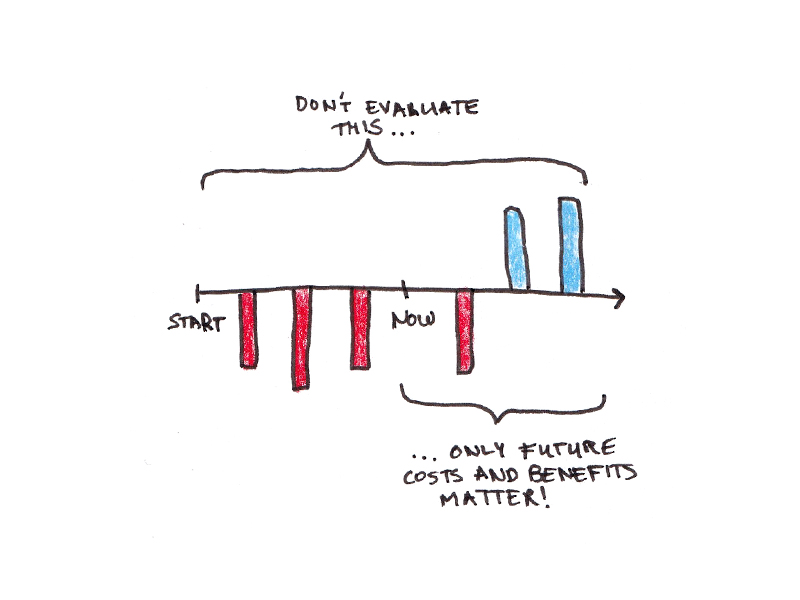
In this case,an analysis of sunk costs discouraged us from quitting early,but it can easily go the other way.
在这个例子里,沉没成本分析让我们选择了坚持。但同样的分析也可能得出相反的结论。
Suppose you've spent three years working on a business idea.Initially,the market looked promising,so you quit your job and spent three years trying to build a company.Now,however,the forecast looks gloomy.You think it will take another three years at least before you can make a go of it—and there are other opportunities that might be better.Should you stay the course,or switch?
假设你花了三年时间打磨一个创业项目。最初市场前景看好,你辞掉工作全力投入。但现在,前景已经黯淡,你估计至少还需要三年才能走上正轨——而与此同时,其他机会也在出现。你该坚持,还是转向?
Once again,the past three years don't matter.Even if those turned out to be a waste of time,they shouldn't change your decision overall.All that matters is whether the future time(and money)you will invest is better spent continuing or quitting.
同样,过去三年的投入不应该左右你的决定。即使那三年最终证明是白费的,也不该改变你现在的判断。真正重要的,是你未来要投入的时间(和金钱),用于继续还是放弃,哪个更划算。
An economic perspective encourages detachment.The question is not "Would I undertake this project if I had to start again?" instead it's "What's the value of continuing versus quitting(compared to my alternatives)?"
经济学视角鼓励我们保持冷静的抽离感。问题不是「如果重来,我还会做这件事吗?」而是「相比其他选择,继续与放弃,哪个价值更高?」
Sometimes a half-finished project you're no longer excited about makes more sense to finish because there's little work needed to complete it.Sometimes a pursuit you poured your soul into needs to be thrown out because the future investment needed to make it work isn't worth the payoff.
有时候,一个你已经不感兴趣的半成品,反而值得完成——因为收尾所需的工作量很小。有时候,一件你倾注了全部心血的事,却不得不放弃——因为让它成功所需的未来投入,根本不值那个回报。
2.Don't rush to act.When's the best point to re-evaluate your exit?
2.不要仓促行动。什么时候才是重新评估的最佳时机?
The economic perspective is useful,but it's only one part of the story.After all,if we could easily make dispassionate decisions about whether to stick it out or give up,deciding what to do—or to quit—wouldn't be so tricky.The real difficulty is that we alternate between feeling unable to let go of projects and abandoning projects for shiny new pursuits,in neither case explicitly weighing the merits of our choice.Emotion,not reason,looms larger in our decision-making.
经济学视角很有用,但它只是故事的一部分。毕竟,如果我们真的能轻松做出理性决定,「坚持还是放弃」就不会那么难了。真正的困难在于:我们时而死死抓住一个项目不肯松手,时而又被新的诱惑吸引而轻易放弃,两种情况下都没有认真权衡利弊。在决策中,情绪的分量往往远超理性。
We can't eliminate our emotions when making decisions.And we wouldn't want to,even if we could.As neuroscientist Antonio Damasio illustrates,patients with damage to emotional centers of their brain are not hyper-efficient Vulcans,rather they're hopelessly lost—wasting hours on unimportant tasks because they can't properly evaluate what matters most.
我们无法在决策时彻底排除情绪,即使可以,我们也不该这么做。神经科学家安东尼奥·达马西奥的研究表明,大脑情感中枢受损的患者并不会变成高效的理性机器,而是陷入迷失——他们会把大量时间浪费在无关紧要的事情上,因为他们无法判断什么才是真正重要的。
But there is a happy medium.One way we can tame some of our worst impulses,without undermining the real value our emotions bring to decision-making,is by creating structures that can influence our decisions.
但我们可以找到一个平衡点。在不抹杀情绪价值的前提下,通过建立一些外部结构来约束我们最糟糕的冲动。
One structure I find particularly helpful is todefine your quitting points in advance.By setting up projects that have well-defined exit ramps,you can ensure you don't make decisions based on momentary temptations.
我发现特别有效的一个方法,是提前设定「退出节点」。为项目设置明确的退出条件,能确保你不会因为一时冲动而做决定。
For instance,I tend to work on learning projects in focused bursts,rather than making lifelong commitments.Part of the reason for this is that it's much easier to commit to learning a new language for thirty days than to assume automatically that I'll want,or be able,to invest in it lifelong.Thirty days is a relatively small commitment,so it's easier to bolster my commitment even when I'm not feeling like it.
比如,我习惯用「专注冲刺」的方式推进学习项目,而非做出终身承诺。原因之一是:承诺学一门语言三十天,远比默认自己要终身学习容易得多。三十天的投入相对有限,即便状态不佳,也更容易坚持下去。
Another structure that can be helpful is creating an automatic delay or review period for any quitting decision.When you're convinced you want to give up,set a reminder in one week or one month to re-evaluate.For bigger goals,you might want to set the reminder once you're past a particularly stressful period—such as deciding whether to quit a job after a big project wraps up,or deciding if you want to switch majors after your final exams—so you're making the decision from relative neutrality.
另一个有效结构,是为任何放弃决定设置一个「自动延迟审查期」。当你确信自己想要放弃时,设一个一周或一个月后的提醒,到时再重新评估。对于更重大的目标,可以把审查时间设在某个高压阶段结束之后——比如在一个大项目收尾后再决定是否辞职,或者在期末考试结束后再决定是否转专业——这样你能在相对平静的状态下做判断。
In both of these cases,the length of the pre-commitment period is crucial.Too short,and you'll allow temporary impulses to drive your decisions.Too long,and you might not be able to endure,defaulting to an emotional response rather than a reasoned one.
在这两种方法中,预承诺期的长度至关重要。太短,你就会让一时冲动左右决策;太长,你可能熬不住,最终还是被情绪驱动。
3.The grass isn't always greener.What's the day-to-day reality of the alternative to my current course?
3.围城效应。那个「更好的选择」,日常现实真的更好吗?
Frustration and stress are only one emotional factor.Distractions can be a far bigger issue.How often have you embarked on one goal only to find yourself pulled toward a new one that seems like a better opportunity?
沮丧和压力只是情绪因素的一部分,分心往往是更大的问题。你有多少次在追求一个目标的途中,被另一个看起来更好的机会吸引过去?
Construal-level theory argues that we tend to evaluate decisions using different frames of reference:we view lofty goals idealistically,omitting their complications and details,and we view daily to-do lists pragmatically,with a focus on what's expedient.But this sets us up for failure,because our current project gets the nitty-gritty treatment,whereas any new pursuit gets viewed through the hazy lens of idealism.Who wouldn't want to switch under those circumstances?
「解释层次理论」指出,我们倾向于用不同的框架评估不同的事情:对宏大目标,我们倾向于理想化,忽略其复杂性和细节;对日常待办事项,我们则务实地聚焦于眼前的可行性。这就形成了一个陷阱:当前的项目被我们放在显微镜下审视,而任何新目标却蒙着一层理想主义的滤镜。在这种情况下,谁不想换一换呢?
One way to overcome this cognitive illusion is togive yourself a brief,realistic experience of pursuing your alternative.If you're thinking about switching majors,take a full class(including homework and exams)from your potential new field.If you're thinking about switching markets,make a prototype and try to pitch it.Low-key commitments often help us realize that the new pursuit has just as many obstacles and challenges as our current one and can temper the desire to switch.
克服这种认知错觉的一个方法,是给自己一段简短而真实的体验,去实际尝试那个「备选项」。如果你想转专业,先去旁听那个专业的完整课程(包括作业和考试)。如果你想进入新市场,先做一个原型并尝试推销它。低门槛的尝试往往能让我们意识到,新目标的障碍和挑战并不比当前的少,从而冷却转换的冲动。
If you're unable to devote time to experience the new pursuit in full detail,it can sometimes be helpful to shift the current project back into the higher construal level to make a fairer comparison.Spend an hour or two journaling about your ultimate goals and values for the project.What originally got you excited about it?
如果你无法抽出时间真实体验新目标,也可以反过来操作:把当前项目拉回到更高的视角,让比较更公平。花一两个小时写下你对这个项目最初的目标和期待——当初是什么让你兴奋?
Finally,a strategy I employ regularly is procrastination.When I get new project ideas,I deliberately put them in a "someday" pile on the back burner.Procrastination is often seen as a vice,but procrastinating on possible distractions means I end up completing more projects.Some of those "someday" projects will make it into reality,but many will be forgotten about entirely as they turned out to be momentary impulses.
最后,我经常使用的一个策略是「刻意拖延」。每当冒出新的项目想法,我会故意把它们放进「改天再说」的清单。拖延通常被视为一种恶习,但对于可能让你分心的事情刻意拖延,反而能帮你完成更多项目。那些「改天再说」的项目,有些终将成真,但很多会就此被遗忘——因为它们本来只是一时冲动。
4.Know your values.Which lines won't you cross?
4.了解你的价值观。哪些底线你绝对不能越过?
Emotions can sometimes lead us to quit impulsively,but they can also lead us to stay in situations we should walk away from.Sometimes,not quitting is the worse decision,because sticking around in a bad relationship,job or project can waste years of our lives with little to show for our time and effort.Indeed,while quitting prematurely has its costs,sticking out to the bitter end of a failed pursuit is the real tragedy.
情绪有时会让我们冲动地放弃,但也会让我们在本该离开的地方苦苦坚守。有时候,不放弃才是更坏的选择——困在一段糟糕的关系、工作或项目里,可能会白白耗掉多年时光。确实,过早放弃有其代价,但死撑到一个失败追求的最后一刻,才是真正的悲剧。
Make clear,bright-line rules about when you'll quit,even if you're tempted to stay.Here are some conditions where I would advocate quitting:
设定清晰、明确的放弃条件,即便你当时很想坚持。以下几种情况,我会建议选择放弃:
The pursuit no longer aligns with your deeply-held values.For instance,if you start a job with one understanding of the work,but later realize that sticking through will require betraying your internal code of ethics or behaving in a way that's contrary to your values,quitting is best.
这件事已经与你的核心价值观相悖。比如,你带着某种理解开始一份工作,后来却发现继续下去需要违背自己的道德准则或价值观,这时候放弃是最好的选择。
The costs of the pursuit clearly exceed its benefits,and there is no clear short-term exit.I often do push myself to finish projects which(mildly)fail the cost-benefit test if the end of the project is near,because I think a moderate degree of perseverance is worth cultivating.But if the costs are dramatically higher than the benefits,or if there is no clear natural exit for the pursuit,quitting is often necessary.
付出明显大于回报,且短期内看不到终点。如果项目快结束了,即便收益略低于成本,我通常还是会督促自己完成,因为我认为适度的坚韧值得培养。但如果成本远超收益,或者这件事根本看不到自然的终点,放弃往往是必要的。
You're trying to recoup a loss that has already occurred.One place human nature tends to irrationally discourage quitting is when we've lost something and are desperate to "undo" that loss.Gamblers call this going "on tilt," where a player is no longer making rational analyses because of bets that went bad.
你试图弥补一个已经发生的损失。人性中有一种非理性倾向,就是在已经亏损时拒绝放手,拼命想要「扳回来」。赌徒把这种状态叫做「倾斜」(on tilt)——玩家已经无法理性分析,只是被之前输掉的赌注驱动着继续赌下去。
Every decision is unique,so there's no single right answer for when to quit.But if you have a process for thinking about those decisions,you'll be more likely to land on a reasonable choice.
每一个决定都是独一无二的,何时放弃没有唯一正确的答案。但如果你有一套思考这类决策的框架,你做出合理选择的概率就会大大提升。
本内容来源于网络 原文链接,观点仅代表作者本人,不代表虎嗅立场。
如涉及版权问题请联系 hezuo@huxiu.com,我们将及时核实并处理。
如涉及版权问题请联系 hezuo@huxiu.com,我们将及时核实并处理。
频道: 社会文化